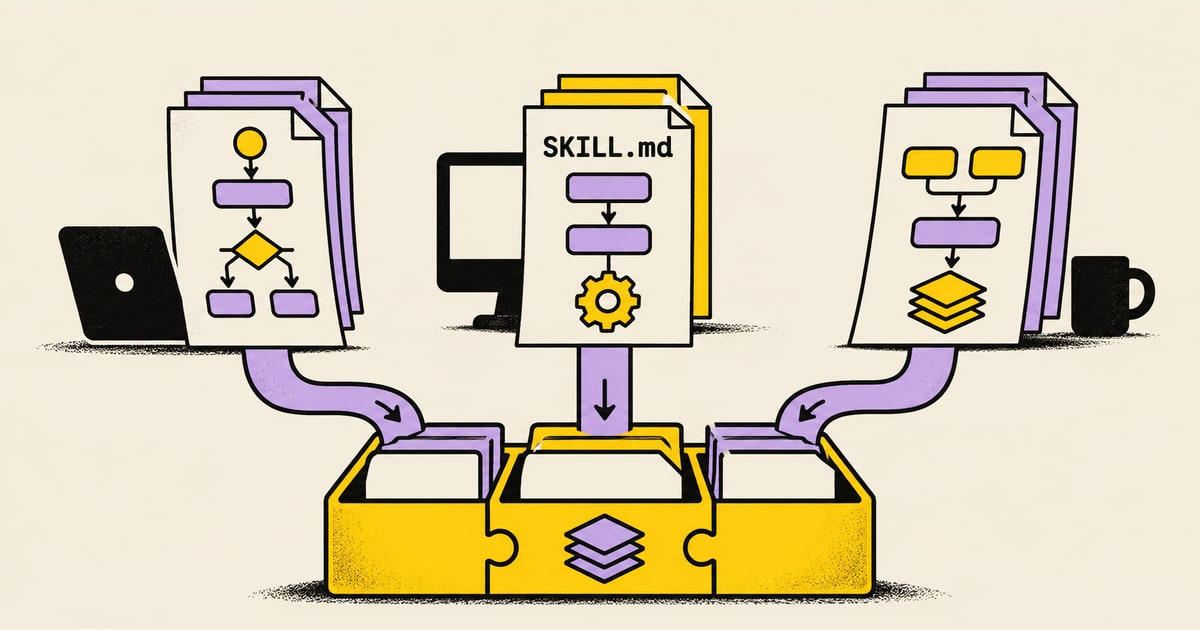
What Anthropic announced
On October 22, 2026, Anthropic announced the donation of Agent Skills to the Agentic AI Foundation under the Linux Foundation. The name, logo, GitHub organization and agentskills.io domain are included. The proposed next steps cover versioned releases, a proposal process and security guidance.
For someone maintaining reusable review or research procedures, the practical question is which parts can travel with their work when the agent changes.
Preserve the method you can explain
Consider a review before a commit. Your checklist might ask for a reproducible input, the effect on existing callers and a verification step. Another person should be able to read that checklist, challenge it and improve it.
Our interpretation is that a procedure you can explain outside the first tool is more likely to remain useful. Read the file as if you were handing the work to a colleague. Mark every step that assumes knowledge of your machine or a command available only in your environment.
Inspect the dependencies before transferring a skill
Imagine a review skill whose checklist is clear but whose script reads an absolute path on its author’s computer. The checklist may still help in a second repository while the script fails. Treat this as an inspection exercise before installation.
Group the contents into the review rules you want to retain, repository details you need to rewrite and operations that require an environment check. Inspect bundled scripts and record the files they read or change. Compare the tools they require with those available in the destination client.
Choose a small task with a known result
For a review, prepare a change with a reproducible error and keep a calculation or test that demonstrates it. Send the same request in each environment and compare the report with that result. Record the client and skill revisions so someone else can understand the conditions.
Then try an unrelated request, such as explaining a function without reviewing a change. Check whether the skill stays out of the task. If you narrow its description, repeat both cases and record the difference. A useful evaluation includes when the procedure should remain inactive.
Use the following record for observations. Each successful run establishes a result for that case and helps you choose the next check.
Task and expected result
...

Skill revision, client and available tools
...

Relevant request and observed behaviour
...

Unrelated request and observed behaviour
...

Finding confirmed by a calculation or test
...

Changes needed before reuse
...Start with a procedure you already understand
Pick a recurring task you know how to assess. A narrow review is a manageable candidate because you can compare each finding with the code and a concrete example. Assess the client’s permissions separately and check what operations the environment actually allows.
Our editorial focus follows from that choice. Publish understandable procedures with cases readers can inspect, then describe the adaptations required when the tool changes.